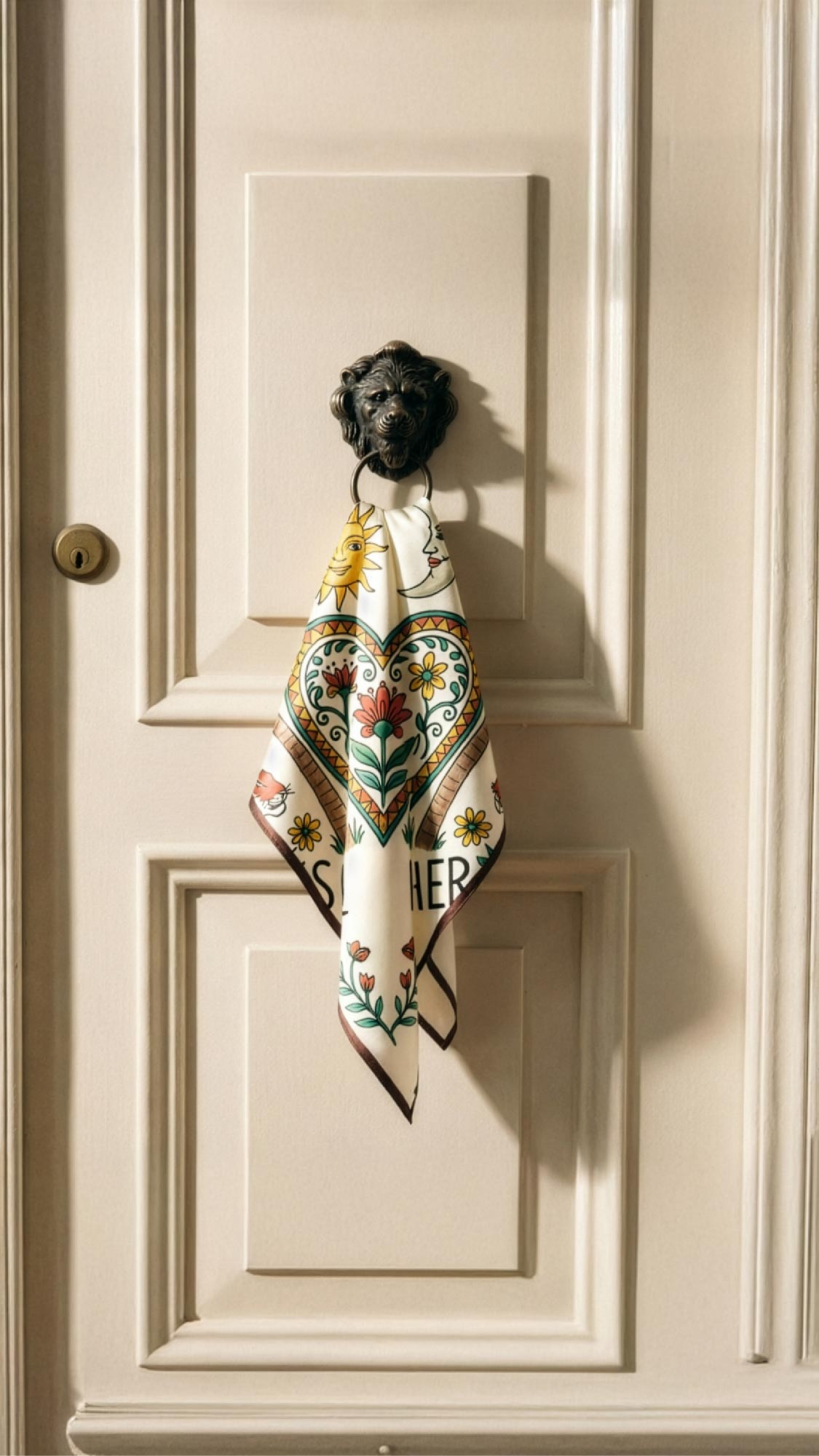
The Art of the Foulard: A Brief History of the Silk Scarf
From Persian royal courts to Parisian fashion houses to global brand icons — the fascinating history of the silk foulard.
A Piece of Fabric with a Remarkable Story
Few accessories have a history as rich, global and enduring as the silk foulard. What began as a practical garment for ancient warriors has evolved into one of the most recognizable symbols of luxury, fashion and personal identity in the modern world.
At Seraya Studios, we produce foulards every day in Como, Italy — the city that has been at the heart of silk production for over five centuries. Every piece we make connects to this long tradition.
Ancient Origins
The history of the scarf stretches back over 3,000 years. Evidence of scarf-like garments appears in ancient Egypt, where Queen Nefertiti is depicted wearing a finely woven cloth beneath her headdress. In ancient Rome, soldiers wore cloth called the focale around their necks to protect against cold and dust.
In China — the birthplace of silk itself — fine woven scarves were worn by the nobility as early as the Zhou Dynasty (1046–256 BC). Silk production remained a closely guarded Chinese secret for centuries, with the technology spreading westward along the Silk Road.
The Silk Road and the Spread of Silk
The Silk Road — the ancient trade network connecting China to the Mediterranean — brought silk to Persia, the Byzantine Empire and eventually to Europe. By the Middle Ages, silk was among the most valuable commodities in the world, prized by royalty and aristocracy across cultures.
Como, in northern Italy, became a center of silk weaving in the 13th century. Its mild climate, proximity to the Alps and entrepreneurial tradition made it the ideal location for silk production. By the 19th century, Como was exporting silk across Europe and beyond.
The Birth of the Modern Foulard
The word foulard comes from the French, derived from the Old French fouler (to press or smooth). In the 19th century, the term came to describe a specific type of lightweight printed silk fabric — and the square scarf made from it.
It was in Paris that the foulard became a fashion icon. French luxury houses began producing elaborately designed silk squares in the early 20th century, transforming a functional accessory into an art form. Iconic designs — featuring equestrian motifs, geometric patterns, botanical illustrations and architectural scenes — became collector's items.
The Foulard in the 20th Century
Throughout the 20th century, the silk foulard became associated with elegance, femininity and status. Grace Kelly famously used a Hermès foulard as a sling to support her injured arm at a 1956 event — creating one of the most iconic fashion photographs of the century.
By the 1960s and 70s, the foulard had transcended gender and class. It was worn by rockstars and royalty, artists and intellectuals. Tied around the neck, the wrist, a handbag or the hair — the foulard adapted to every era and every personal style.
The Foulard Today
Today, the silk foulard remains as relevant as ever. Luxury brands continue to produce iconic collections. Contemporary designers experiment with new formats — twillies, oblong scarves, bandanas — while honoring the tradition of printed silk.
For brands, hotels and corporations, the custom foulard has become a powerful tool of identity: a wearable canvas for a logo, a pattern, a story. Made in Como, printed with precision, worn with pride around the world.
At Seraya Studios, we are honored to continue this tradition every day.
Ready to Create Something Extraordinary?
Contact us for a free custom production quote. Made in Como, Italy.
Request a Quote